Talk to an expert 504-608-4680
Talk to an expert 504-608-4680

Written by Big Easy Pool Builders
Key Takeaways
Quick Answer: A salt water pool still uses chlorine; a generator makes it from dissolved salt, so you stop hauling and dosing chlorine by hand. With Louisiana’s long swim season that convenience adds up. The tradeoffs are a conversion HomeAdvisor’s 2026 guide puts at $500 to $2,500 nationally, plus periodic cell replacement, and extra care around stone and metal.
In Hammond or LaPlace, our advice is to start with the name. “Salt water” sounds like the Gulf, and “chlorine” sounds like the smell at a public pool. Both pools sanitize with chlorine. What changes is where the chlorine comes from and what the salt does to everything around the water.
Hayward’s AquaRite owner’s manual describes it plainly: the system needs a low concentration of salt (sodium chloride) in the water, and the generator converts that salt into free chlorine, which kills bacteria and algae. After the chlorine does its work, it reverts to sodium chloride, and the cycle repeats.
The salt level is low. Hayward lists 2,700 to 3,400 parts per million as ideal, with 3,200 as optimal, and says most people start to taste salt around 3,500 to 4,000 ppm. For comparison, NOAA puts average seawater salinity at about 35 parts per thousand, which works out to 35,000 ppm. A salt pool sits at roughly a tenth of that.
Keep the level in range. Hayward says low salt cuts chlorine output, and high salt can make the unit shut down.
HomeAdvisor’s 2026 salt water pool guide puts a conversion at $500 to $2,500; the pool’s size and type decide where you land. HomeGuide’s salt water pool cost guide lands inside that at $600 to $2,200 as of 2023. Both are national ranges, not our pricing.
HomeGuide’s national breakdown for a 50,000 gallon inground pool, as of 2023, looks like this:
On the running side, HomeAdvisor’s 2026 guide estimates nationally that the generator adds about $50 a year in electricity, while salt costs less than the chlorine it replaces. HomeGuide’s national figures, as of 2023, put a chlorine pool at 1 to 2 buckets of tablets a year, or $100 to $755, before other balancing chemicals.
The cell is the part that makes chlorine, and it wears out. HomeGuide’s national figures, as of 2023, put replacement at $500 to $800 every 3 to 6 years. That’s the recurring cost owners forget when they compare salt against a bucket of tablets.
Hayward’s manual asks you to open and inspect the cell every 3 months, and its control flashes an “Inspect Cell” light after about 500 hours of run time. The cell cleans itself in most cases, but hard water or chemistry left out of balance can build scale on the plates. If that light stays on after a thorough cleaning, the cell may be worn out. Hayward also says to scrape scale with plastic or wood, never metal, which scratches the plate coating.
If your generator is acting up, our guide to diagnosing common pool equipment failures can help you narrow it down, and our post on pool equipment repair vs. replacement covers when a new cell makes more sense than another cleaning.
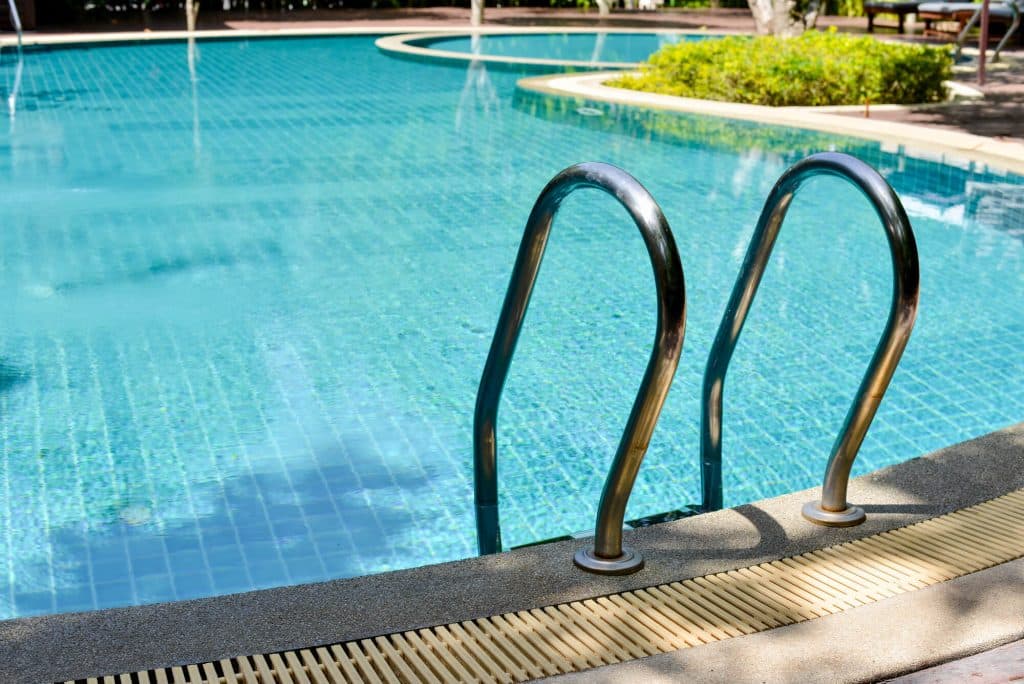
Our advice is to settle this part of the decision before anyone picks coping. Hayward’s manual says that if a salt system goes on a pool with natural stone coping or stone decking right beside it, you should first consult a qualified stone installation specialist about the stone type, installation, sealant, and upkeep for your location.
The reason is how salt behaves in porous stone. Litos, a natural stone trade publication, explains that salty water evaporating just below the surface leaves crystals inside the stone. As they build up, they press outward and flake the surface. Its advice is to seal stone on all 6 sides, especially the coping.
Metal is the other concern. HomeGuide warns that salt water splashed onto metal will eventually corrode it, and suggests rinsing spills quickly. Salt splash-out can also kill nearby grass and some plants. If you’re planning one of our custom pool builds, we recommend choosing coping stone and railings with the sanitizer in mind, and our explainer on what a gunite pool is covers the shell itself.
We get a lot of it. The National Weather Service’s 1991 to 2020 normals for New Orleans International Airport show 63.35 inches of rain a year, with June at 7.62 inches, July at 6.79, and August at 6.91.
Hayward notes that salt isn’t lost to evaporation. It leaves when water leaves, through splashing, backwashing, or draining after rain. A summer downpour that overflows the pool dilutes salt and chlorine together. For heavy rain, Hayward’s control has a Super Chlorinate setting that boosts output for 24 hours.
The season is long, too. At the airport, average daily temperatures stay above 70 degrees from April through October, so a generator in this part of Louisiana logs a lot of hours. We recommend testing salt and chlorine after every big storm and keeping the cell inspections on the calendar.
Here’s the general sequence, drawn from Hayward’s manual and HomeGuide:
Two timing notes. For new plaster, the National Plasterers Council’s start-up procedure says not to add salt for at least the first 30 days. Hayward’s manual gives a shorter 10 to 14 day window, but we recommend following the plaster start-up guidance, so plan around a resurfacing; our post on pool replaster cost in New Orleans covers that job. And salt pools use the same heaters as chlorine pools, so our guide to pool heater cost in Louisiana still applies.
Salt fits owners who swim most of the year and want steadier chlorine without handling tablets, and who are willing to budget for cells. Chlorine fits owners with a lot of natural stone or metal near the water, or anyone who wants the lowest upfront cost. Building new? Settle it during design, before coping gets ordered; our post on how long a gunite pool build takes shows where that decision lands on the schedule.
Yes. The generator turns dissolved salt into chlorine, and that chlorine sanitizes the water just as it would in a traditional pool.
Not at normal levels. Hayward says most people begin to taste salt around 3,500 to 4,000 ppm, above its recommended range.
No. The National Plasterers Council’s start-up procedure says not to add salt for at least the first 30 days. Hayward’s manual lists a shorter 10 to 14 days, but follow the plaster guidance.
It can. Rain that overflows the pool or forces you to drain carries salt out with the water.
We build and service pools in Hammond and LaPlace as well as the wider New Orleans metro. If you want a salt system added to your pool or a worn cell replaced, our pool equipment repair team can walk your equipment pad and your stone before you decide. Contact us or call (504) 608-4680.
 By Admin
  Sep 29, 2026