

Talk to an expert 504-608-4680
Talk to an expert 504-608-4680

Written by Big Easy Pool Builders
Key Takeaways
Quick Answer: A gunite pool is an inground concrete pool built by spraying a dry cement and sand mix, hydrated at the nozzle, over a steel rebar frame shaped to your excavation. The sprayed concrete forms the pool shell, which then gets a finish coat such as plaster. It’s how we build custom pools across New Orleans and Metairie.
The word sounds like a brand name, and it started out as one. Today it just describes a way of placing concrete. When a builder in Metairie talks about “shooting the pool,” this is the day they mean. Our advice: be home for it if you can, because it’s the day the hole in the yard starts to look like a pool.
A gunite pool has two layers you’ll never see once it’s full, and one you’ll touch every time you swim.
Steel. After the dig, the crew ties a grid of steel rebar that follows the shape of the hole. SwimmingPool.com describes that rebar framework as the grid that reinforces the pool and spa structure. It wraps the steps and follows every curve in the design.
Concrete. The gunite itself is concrete. The American Shotcrete Association (ASA) describes the dry-mix process as sending dry materials, “often just a coarse sand and cement mixture,” through a hose and injecting most of the water at the nozzle. The mix hits the steel at high velocity and builds up the floor and walls in layers. Plumbing lines are set before the shoot, so the concrete forms around them.
The finish. The shell isn’t the surface you swim on. It gets an interior finish, usually plaster, a pebble finish, tile, or a combination. That finish wears over time and gets renewed, which is what pool replastering takes care of.
Close enough that the terms get mixed up constantly. In a 2018 article for ASA’s Shotcrete magazine, Mason Guarino and Ryan Oakes explain that gunite and shotcrete are placement methods, not materials. “Gunite” was the trade name for the dry sand and cement mix shot from the Cement Gun Company’s equipment. When the American Concrete Institute began writing standards for pneumatically placed mortar in 1951, it adopted “shotcrete” as the general term.
So today, dry-mix shotcrete is what the pool world calls gunite. Wet-mix shotcrete pumps concrete that’s already mixed and adds air at the nozzle. The same article concludes that both processes work well when a well-trained crew places them with the right materials. In other words, the crew behind the hose matters more than the label on the truck. ASA also recommends using an ACI-certified shotcrete nozzleman.
This is the part of the build most homeowners never ask about, and it’s worth a question. The Guarino and Oakes article notes that many pool builders consider 2,500 psi of 28-day compressive strength adequate. ASA’s position is higher: a minimum of 4,000 psi, which it ties to proper encasement of the steel and a durable, watertight shell.
Curing matters just as much. ASA recommends at least 7 days of curing to help control shrinkage in young concrete, and it warns that heat and dry wind raise the risk of shrinkage cracking. A New Orleans summer delivers plenty of heat. Our recommendation for a summer shoot: agree on how the shell will stay wet before the gunite truck ever shows up.
Because gunite is sprayed in place, it isn’t limited to a set of molds. SwimmingPool.com calls it “ideally suited for curves, freeform designs, and unusual shapes.” That’s useful on narrow city lots and in backyards with an oak tree you want to keep. Our guide to choosing the right pool size and shape walks through those decisions, and our custom pool design work starts from your yard’s footprint.
Our metro sits on soft alluvial delta soil that can shift and settle. No pool shell gets to ignore that. ASA lists inadequate reinforcing steel and construction on poor soil among the common reasons pool shells crack. With gunite, the steel layout and the prep under the shell are designed for each site, so they deserve as much attention as the shape. Groundwater can be part of that conversation on local lots too.
An attached spa or built-in benches can be formed in the same shell as the pool. If a hot tub is on your list, see our spa construction page.
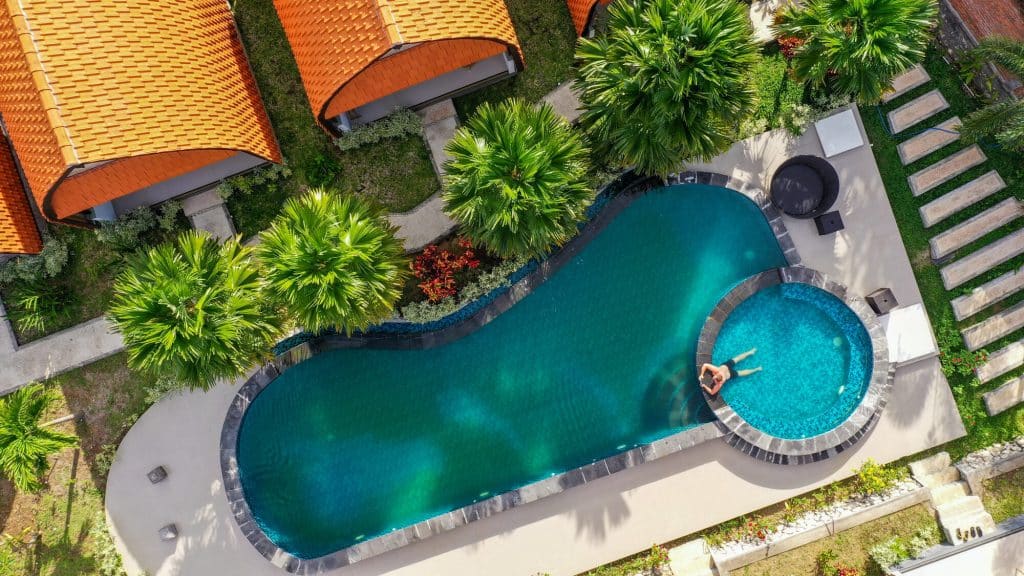
HomeGuide’s gunite pool guide, updated July 2025, says gunite pools last 50+ years on average. It also notes that the outer layer degrades over time, and it recommends acid washes every 3 to 5 years and resurfacing every 10 to 15 years. The shell is the long-term part. The finish is what you maintain.
Our climate is hard on that finish. We swim most of the year under an intense summer sun. SwimmingPool.com points out that gunite’s porous surface calls for more frequent chemical treatment and brushing to keep algae away. Steady water chemistry is the cheapest way to stretch the time between resurfacing jobs.
HomeGuide describes gunite as typically the most expensive pool material, and also the one known for customization and a longer lifespan. Whether that’s worth it depends on what you want from the backyard.
Gunite makes the most sense if you want a shape built for your lot or a pool you plan to keep for decades. It’s a harder sell if the quickest possible install is your top priority, since concrete needs time to cure. If you’re still deciding between pool styles, our post on inground vs. above-ground pools covers the bigger choice, and the benefits of owning a pool may help with the “should we” question.
A few questions at the consultation tell you a lot about how a builder handles the structure:
We’re happy to answer all of them on your project. You can see how we approach the structure on our gunite pool construction page.
Yes. Gunite is concrete. The word describes how it’s placed: sprayed from a hose as a dry mix that’s hydrated at the nozzle.
ASA recommends a minimum of 7 days of curing, and it sets its strength target at 28 days. Your builder decides when the shell is ready for tile, coping, and the finish coat.
You don’t touch the gunite itself. You touch the finish coat, and a pebble finish feels different underfoot from smooth plaster. Ask to feel samples before you pick one.
Yes, and much of our service area is soft ground. The key is designing the steel and site prep for your lot, since poor soil and weak reinforcing are both common causes of shell cracks.
If you’re weighing a gunite pool for a home in New Orleans or Metairie, we’ll walk your yard, talk through shapes, and explain how we’d build the shell on your lot. We also work across the Northshore and Baton Rouge; see our full list of service areas.
Request a free consultation or call (504) 608-4680. Want to learn more about the build itself? Start with our gunite pool builders in New Orleans page.
 By Admin
  Sep 24, 2026


