Talk to an expert 504-608-4680
Talk to an expert 504-608-4680

Written by Big Easy Pool Builders
Key Takeaways
Quick Answer: HomeGuide’s 2026 cost guide puts an installed pool heater at $1,500 to $4,500 for gas, $2,000 to $6,000 for a heat pump, and $2,500 to $6,500 for solar. Those are national ranges, not our quote. In Louisiana’s mild climate, a heat pump fits owners who swim most of the year and want lower running costs.
If you’re in Mandeville or Covington, we suggest pricing a heater before fall, when the water starts to feel cool in the morning. A heater stretches the season into spring, fall, and sometimes winter, so the right pick depends on how many months you want to swim.
Running cost decides which heater is cheaper over its life. Here’s how the HomeGuide 2026 pool heater cost guide lays out national figures:
| Heater type | Installed (national) | Unit only | Typical running cost |
|---|---|---|---|
| Gas (natural gas or propane) | $1,500 to $4,500 | $1,000 to $3,000 | $200 to $500+ per month |
| Heat pump | $2,000 to $6,000 | $1,500 to $5,000 | $50 to $150 per month |
| Solar | $2,500 to $6,500 | $2,000 to $5,000 | $10 to $25 per month for the circulation pump |
A gas heater burns natural gas or propane to warm the pool water as it circulates. HomeGuide notes that gas warms water quickly and works at any air temperature, but it’s the least energy-efficient option and has the shortest lifespan. It also has to be vented away from the pool so fumes don’t settle over the water.
A heat pump pulls heat out of the outdoor air and moves it into the water. It costs more up front than gas, and it warms the pool more slowly, but the monthly bill is a fraction of what gas runs. Installed ranges vary by guide.
Solar collectors, mounted on a roof or near the pool, warm the water as the pump circulates it through them. DOE’s archived solar guidance says collector area should equal 50% to 100% of the pool’s surface area, and that a pool cover lets you get by with less of it. It calls a site with unshaded areas that generally faces south a good candidate.
DOE’s Energy Saver guidance says heat pump pool heaters work efficiently as long as outdoor air stays above the 45 to 50 degree range. It rates them by coefficient of performance (COP), usually 3.0 to 7.0. In plain terms, each unit of electricity moves 3 to 7 units of heat into the water. DOE also says heat pumps typically carry much lower annual operating costs than gas heaters and tend to last longer.
The National Weather Service’s 1991 to 2020 normals for New Orleans International Airport show a January average temperature of 54.3 degrees, February at 58.0, and December at 56.6. Average January lows sit around 46 degrees, right at the edge of that efficient range, so a heat pump works hardest on the coldest nights.
DOE lists low humidity, surface wind, and cool nights as things that push heater size up. Gulf humidity works in your favor on that list. The airport sits on the south shore, so check your own thermometer in Covington.
Gas still has a place. HomeGuide points out that gas heaters are most efficient for short heating runs, which suits owners who swim only on weekends. The same quick warm-up makes gas worth a look for an attached spa you heat on demand. If a spa is part of your plans, our spa construction page covers how we build them.
DOE’s sizing method for heat pumps starts with the pool’s surface area, since that’s where heat escapes, and the temperature rise you want. The steps:
Here’s how it plays out for a 15 by 30 foot pool (450 square feet) aiming for 82 degrees. Swimming from March on, the airport’s March average of about 64 degrees means an 18 degree rise, and 450 x 18 x 12 comes to 97,200 Btu per hour. That’s close to DOE’s standard 5 hp, 100,000 Btu size. Push the target into January, when the average is about 54 degrees, and the need climbs to roughly 151,000 Btu per hour.
HomeGuide offers a simpler rule of thumb: at least 50,000 BTUs for every 5,000 to 10,000 gallons in mild climates. Treat both as starting points; DOE recommends a proper sizing analysis by a trained pool technician. Shape matters too, since a long lap pool has more surface than a compact one. Our guide to choosing the right pool size and shape covers that tradeoff.
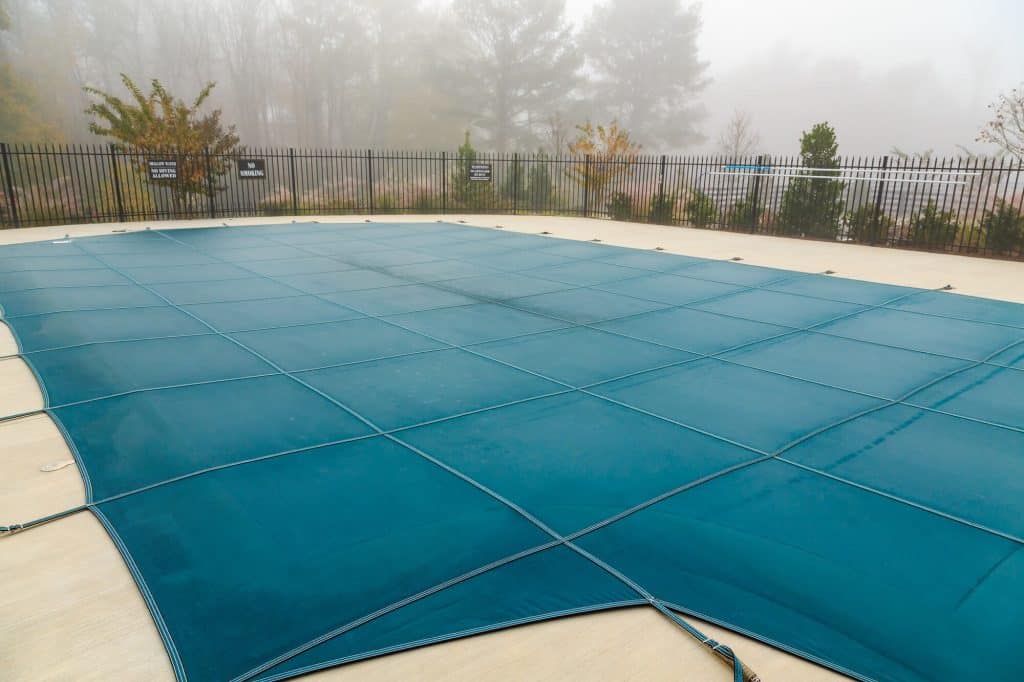
DOE’s cost table for heat pump heating models a 1,000 square foot outdoor pool with a COP of 5.0. For Miami, the closest match to our climate on that list, holding 80 degrees year-round came to $1,989 a year uncovered and $409 with a cover. The table uses an older electric rate, so read it for the proportion: the cover cut heating cost to about a fifth.
Utility work is the line item people forget. HomeGuide’s 2026 guide puts a new gas line at $15 to $50+ per linear foot nationally, installed with permits included, so distance from the meter matters. For a heat pump, DOE’s archived guidance says a qualified pool installer should handle the electric hookup. HomeGuide says installation takes 1 to 2 days, plus 2 more if the unit needs a new concrete pad.
When you plan equipment on a new build, we recommend putting the pad where heavy summer rain drains away from it and leaving room for service access. If you’re still at that stage, our custom pool design process includes equipment layout, and our explainer on what a gunite pool is walks through the shell itself.
HomeGuide says pool heaters last 10 to 12 years on average. Gas units run shortest, at 7 to 8 years, while heat pumps and solar can reach 15. DOE’s solar guidance says a well-maintained solar system can keep running 10 to 20 years.
If your current heater is acting up, start with our guide on whether a pool heater needs repair or replacement before you shop. Our rundown of common pool equipment failures can help you sort a heater fault from a pump or flow problem. And if the pool is due for new plaster anyway, it’s a sensible time to upgrade equipment; see what replastering costs in New Orleans.
It fits owners who swim through spring and fall and want lower running costs. Winter days here mostly stay above DOE’s 45 to 50 degree line, while nights sit right at the edge: NWS normals put average lows at 46.1 degrees in January, 49.7 in February, and 48.4 in December.
Not as fast as gas. HomeGuide notes heat pumps take longer to warm water, so gas is worth pricing for a spa you heat on demand.
No. HomeGuide says salt water pools use the same heaters as chlorine pools.
We build and equip pools across the Northshore, including Mandeville and Covington. Whether you’re adding a heater to an existing pool or planning one into a new build, our pool equipment repair and installation team can size it to your pool and your swim season. Contact us or call (504) 608-4680 to set up a visit.
 By Admin
  Sep 26, 2026