

Talk to an expert 504-608-4680
Talk to an expert 504-608-4680

Written by Big Easy Pool Builders
Key Takeaways
Quick Answer: HomeGuide’s resurfacing guide, updated April 2025, says most pools need resurfacing every 7 to 15 years, and the finish sets where you land. Standard plaster wears out before quartz and pebble, and pebble can go 20 years or more. In New Orleans, how well you hold your water chemistry through the long swim season matters as much as the calendar.
So there’s no single date to circle. Our advice for owners in St. Rose and Baton Rouge: judge the surface itself, not the calendar, because two pools plastered the same year can age very differently.
Sources don’t agree on one number, so here’s the honest spread. HomeGuide’s resurfacing guide, updated April 2025, gives these national lifespans:
Other sources stretch the range in both directions. Pebble Technology International, which makes PebbleTec, says plaster finishes need resurfacing every 5 to 10 years and its pebble finishes can last over 20 years with proper maintenance and chemistry. The National Plasterers Council, the trade group for pool plasterers, says plaster can last up to 20 years with proper care.
Put those together and plaster can wear out anywhere from about 5 years to 20, and care makes most of the difference. If you want to know what a new surface would cost once you get there, our guide to what it costs to replaster a pool breaks down national prices by finish.
Your pool tells you when it’s ready. HomeGuide lists these signs that a surface needs resurfacing:
One sign you can hear instead of see is delamination, where the finish separates from the layer beneath it. Universal White Cement, a cement maker, describes well-bonded plaster as producing a crisp, tight sound when tapped, while delaminated areas sound dull or hollow. A small isolated spot may be patchable. If the hollow areas spread across a wall or floor, you’re looking at a full resurface.
Our advice for Baton Rouge owners: don’t shrug off roughness. HomeGuide lists a rough texture among the signs a surface needs work, so if swimmers start snagging suits or scraping feet on the floor, have the finish checked.
Plaster is a cement product, and water that’s out of balance slowly dissolves it or leaves scale on top of it. Pebble Technology International says balanced pH, alkalinity and calcium hardness keep a surface from deteriorating early, and warns that poorly balanced water can weaken the cement until pebbles come loose.
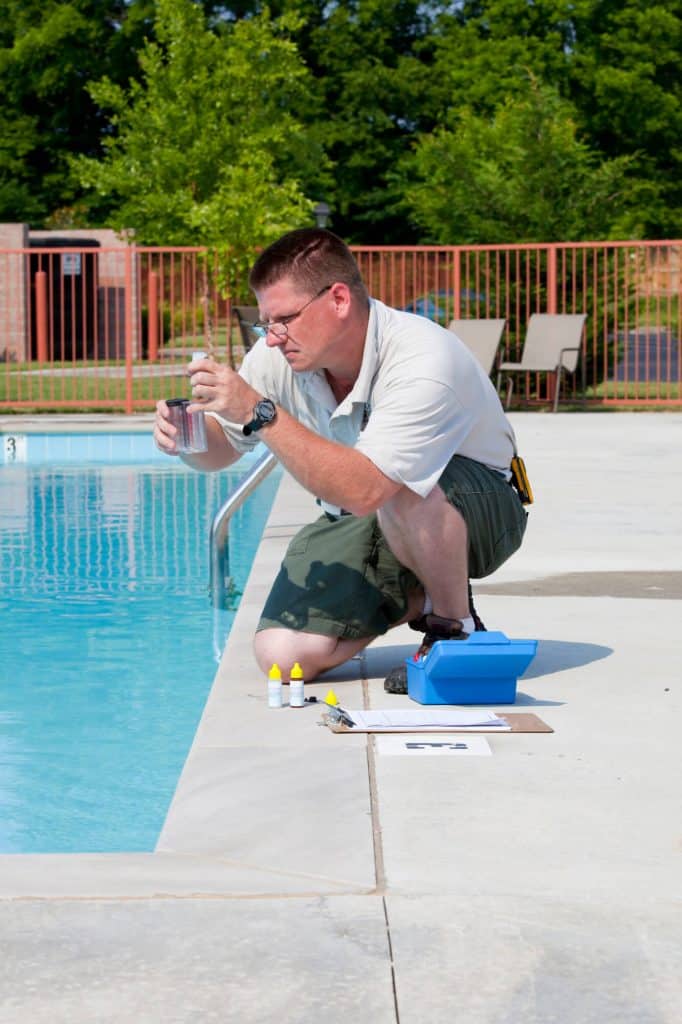
Regular testing is the simplest habit that protects a finish. If you run a salt system, the chemistry questions change a little, and our comparison of salt water and chlorine pools in Louisiana covers what to watch. If the salt cell itself acts up, our pool equipment repair service can check it.
It makes the job of protecting it harder. Pebble Technology International names harsh sunlight and heavy rainfall among the conditions that wear finishes down, along with how often and how hard a pool gets used. South Louisiana has plenty of sun and rain, and our long swim season means the pool gets used for more of the year.
Summer afternoon storms deserve extra attention. A heavy downpour dumps a lot of fresh water into the pool and can knock your balance off in a single afternoon. Our advice in St. Rose and Baton Rouge: retest after a big storm instead of waiting for the next weekly check. Hurricane season adds storm debris to the list, so skim and brush after every blow.
A new surface keeps curing long after the crew leaves. The National Plasterers Council’s start-up procedure calls for brushing the entire pool at least twice a day to remove plaster dust, and it notes that 30 days after the first fill, hydration of the new finish is only 60 to 70 percent complete.
That means the first weeks shape the finish’s whole life. The same procedure warns that improper start-ups can cause scale, etching, metal stains, and discoloration. It also calls for holding the Langelier Saturation Index, the measure the NPC uses for how aggressive pool water is, between 0.0 and +0.3 through the first six months. If you’re building new, the plaster goes on near the end of the job, and our gunite pool build timeline shows where it fits.
Waiting too long usually costs you. Once flaking or hollow spots spread, patching stops being an option, and HomeGuide notes that resurfacing extends a pool’s life by preventing new cracks and leaks from forming. Our guide to what a gunite pool is explains how the shell and the finish fit together.
Resurfacing too early wastes money on a finish that still had years left. Stains alone don’t always mean replastering, so have someone check the surface before you commit. HomeGuide puts a typical resurfacing job at 5 to 7 days, so plan it for a stretch when you can spare the pool.
HomeGuide puts standard plaster at 7 to 12 years. PebbleTec’s maker says 5 to 10, and the National Plasterers Council says up to 20 with proper care. Your chemistry decides where you fall.
Outside peak swim season is easiest, since you won’t lose the pool in July. Ask your builder how summer storms could affect the schedule.
Small, isolated spots can often be patched. Hollow or flaking areas that cover a whole wall or floor usually mean a full resurface.
It lasts longer, but it still needs balanced water. Poor chemistry can loosen pebbles over time.
If your plaster feels rough or looks tired, we’ll take a look and tell you honestly whether it needs work now or can wait. Learn more about our pool replastering service, or see the areas we cover in St. Rose and Baton Rouge.
Have more questions first? Our pool FAQs cover scheduling and service. Schedule a finish inspection or call (504) 608-4680.
 By Admin
  Sep 30, 2026


